
More about Subsistence Farming
When European settlers first arrived in what is now Warren, Maine, they did not come to establish large commercial farms. Most families were simply trying to survive. Their goal was to produce enough food, fuel, and building materials to support themselves through the long Maine winters.
Three hundred years ago, this area was almost certainly covered by a mature forest of towering eastern white pines, mixed with hemlock, maple, beech, and oak. Many of the white pines may have been over 200 years old and far larger than the century-old pines standing nearby today.
Transforming that forest into farmland required years of exhausting labor. Trees were felled one at a time using axes. The logs became cabins, barns, fences, furniture, tools, and firewood. Some of the tallest and straightest white pines may have been claimed by the British Crown as “King’s Pines.” During colonial times, these prized trees were reserved for ship masts used by the Royal Navy, and cutting them without permission could bring severe penalties.
Removing the trees was only the beginning. Every stump had to be dug from the rocky soil before the land could be plowed. Oxen were often preferred over horses because they were stronger, easier to feed, and better suited for pulling heavy stumps, hauling logs, and working rough ground. Even after the land was cleared, farmers spent countless hours removing stones that frost pushed to the surface year after year. Those stones eventually became the stone fences and rock piles you will see elsewhere along the trail.
The first crops were chosen for one reason—they had to keep a family alive. Corn, beans, potatoes, squash, pumpkins, turnips, and cabbage were common because they grew reasonably well in Maine’s short growing season and could be stored through the winter. Hay was equally important because livestock depended on it once snow covered the fields.
Most pioneer families owned only a few animals. Chickens supplied eggs and meat. One or two cows provided milk, butter, cheese, and occasionally beef. Pigs converted kitchen scraps and forest forage into meat that could be salted for winter. Sheep may have been kept in small numbers for wool, although large-scale sheep farming did not become common in Maine until the early 1800s. Every animal had to earn its keep because feeding livestock through a Maine winter demanded valuable hay and grain.
The forest continued to play a vital role in everyday life. Families gathered firewood, wild berries, nuts, mushrooms, maple sap, and medicinal plants. Hunting supplied deer, moose, bear, rabbits, grouse, and wild turkey, while nearby streams and ponds provided fish whenever possible. The farm and the surrounding forest worked together as a single system that supported the family.
Although no written record tells us exactly what was grown or raised on this property, the evidence suggests that it followed the same pattern as countless other small homesteads throughout Midcoast Maine. The settlers who lived here almost certainly relied on a combination of crops, livestock, and the surrounding forest to survive.
One of the remarkable things about this property is that it preserves the story of changing land use over nearly three centuries. It likely began as an old-growth forest before being cleared for subsistence farming. As Maine’s economy changed, the land evolved into sheep pasture, later supported dairy farming, and eventually was used for commercial blueberry production. Today, nature is reclaiming the pastures, and a new forest is slowly growing where generations of people once worked.
As you continue along the Mindfulness Trail, you’ll discover that the forest has not forgotten its past. The rock piles, stone fences, unusual trees, and even the shape of the land all preserve clues to the people who lived and worked here. Learning to recognize those clues is one of the central ideas behind this trail. The landscape is more than scenery—it is a living historical record, waiting to be read.
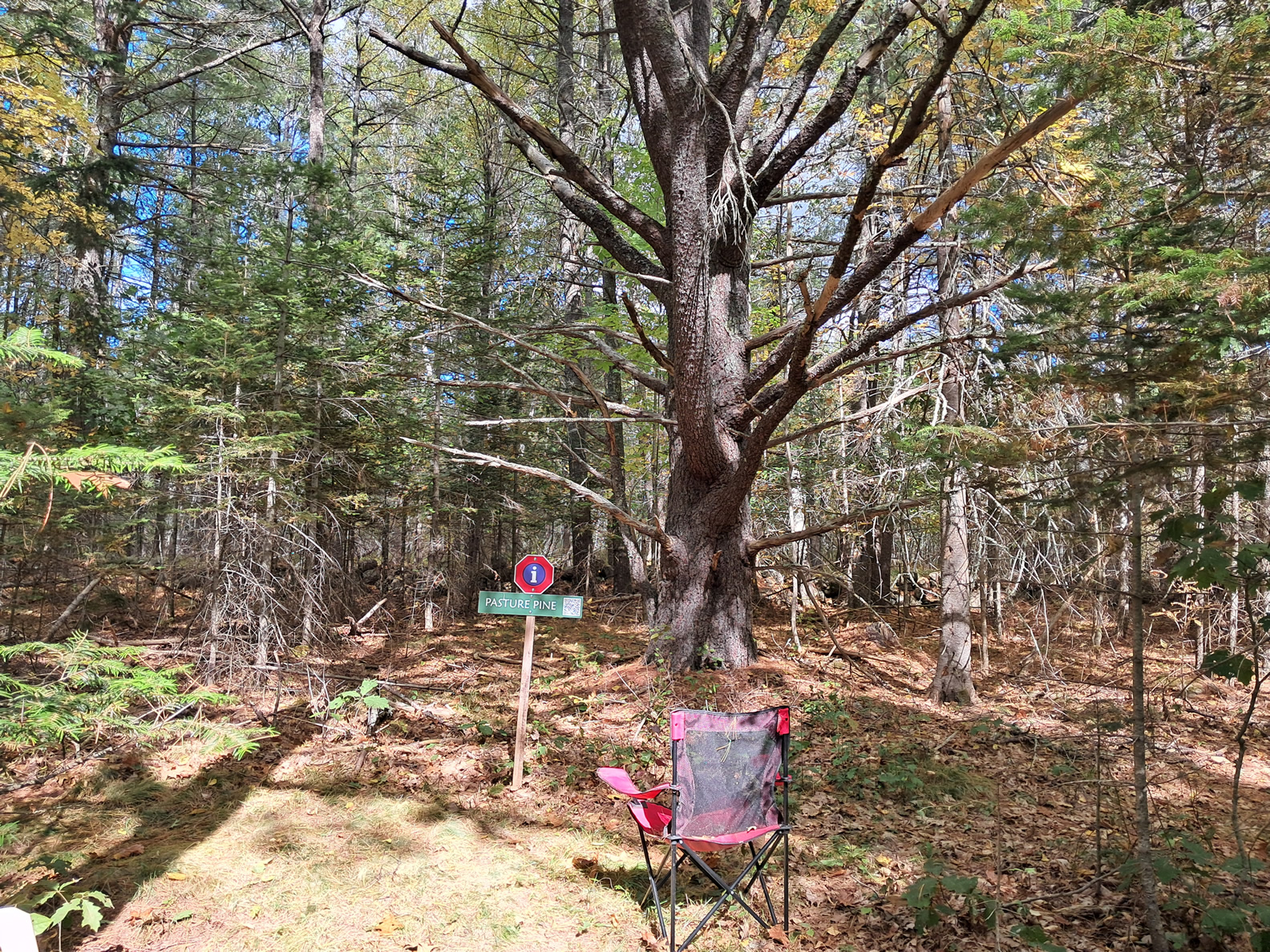
Pine Tree Dating and Mapping Project:
The purpose of this project is to determine the age and location of pine trees. In a forest like this one, which has been periodically disturbed by humans over the centuries, we can determine landscape changed by studying how pine trees have proliferated. Pine trees typically are among the first to colonize open spaces. Knowing when a pine tree sprouted helps reveal when a pasture of clear cut area was abandoned. With a detailed map we can visualize boundaries and timing of changes to the landscape.
Please support all our projects with a donation! All funds will be used to support volunteers and our educational mission.
For a limited time we can match your donation dollar for dollar!
We do not share your information with anyone!
Our Privacy Policy